THIS HORSEMANSHIP
...therefore concentrates on specific elements which are considered useful in, and are shared by,
certain other equestrian specializations, for some forms of equestrianism they are of little
value, and for others they are deemed counterproductive. But, as I shall try to elucidate, while as a specialization this
riding has its own demands, its principles, if truly followed, are the
generalizable canons of all work with the horse that is appropriate for
the animal and dignified for the human being. … therefore aims at making the horse capable of doing certain things in a certain manner. The insistence on purity and perfection of movement means that this horsemanship aspires to show the Horse's essence when presenting a horse, to cultivate the exemplary in the particular. To this purpose, this form of horsework is an undertaking of stylization.
Properly undertaken, this civilizing work leads to a portrayal of the
"heart" of the horse's nature, to his capacity to perform complexity as
if it were simplicity, and to him being able to do the difficult with
the appearance of utter naturalness. …confronts a very particular problematic: To make these
specific objectives one's focus while respecting the above-mentioned
fundamentals is complicated by the fact that supreme mobility in high
collection is, in the "natural" horse, to a large extent associated
with excitement, with a
momentarily unsettled state induced by disturbance. To be able to
elicit these behaviors from the horse by gentle, invisible indications,
to make him exhibit such movements in calmness and comfortably and
to carry out the rider's demands collaboratively, continuously, and
joyfully, requires that the horse while finding back to his nature be transformed in his nature without being deformed.
…obtains this specialized stylization neither by indoctrinating the horse nor by extracting behavior from him abusively. It shapes
the horse so that he be capable of understanding the rider's request
and of carrying it out. In the preparatory stages, this calls upon the
skill to make the horse receptive and teachable,
so that one can undertake exercises which one chooses and interweaves
knowledgeably and thereby come to train the horse's body. When this
introductory phase has progressed and matured sufficiently, it is time
to widen the scope and variety of behaviors and movements
and to increase the difficulty of fluid transitions between them. This
requires increased complexity in the interaction between rider and
horse. Finally, the task (a never-ending task) lies in giving the horse
polished shape, to aim for refinement.
...understands itself as an undertaking of deep-going and respectful modification of nature in which the aesthetic component is always present. Progress in schooling is always
borne out in the horse's brilliance, brio, and beauty becoming
heightened. Initially limited by the horse's natural gifts and strained
by the unnatural imposition of the rider, the blooming of these
qualities is the concrete testimony of correct work. Over time and with the increasing competence of horse and rider, the aesthetic element must become more and more central,
both as a focus as well as a practical result. Attaining refined and
beautiful stylized mobility in collection can be considered an artful result.
...in its modern form is the confluence of all these ideals, incorporates the heritage of all these "ancestors".
In this sense, this horsemanship is not merely one specific way of doing
things practically or a particular manner of theoretical thinking
concerning riding: Behind these "surface" appearances, this
specialization is a full-fledged value system,
a philosophy, an aesthetic, a logic, and an ethics of horsemanship. How
these historically inherited elements are combined, how important any
one of them is in practice, may vary. But any manner of riding which
gives no consideration at all to one of these elements or which favours
a practice contrary to any of these values, does not belong to the
horsemanship we speak about here. ... takes its traditions not to be abstract desiderata to
which one pays lip service but which one suspends in one's actual ways of doing, rather it holds them to be precepts for practice. This horsemanship therefore requires a harmonious balance
between theoretical comprehension acquired through study and concrete
practical know-how resulting from experience, on the one hand, and an unwavering
adherence to practice (and to be able to practice) in concordance with
theory, on the other. Because reliance on sheer
hands-on competence or on highflying theoretical grasp alone, or an
undue overestimation of the one over the other, is insufficient
the fundamental methodology of
this horsemanship is not to faithfully follow a "system" but to search critically. …adheres to these conceptual values and practical standards because this way it serves the horse and therefore the rider's purpose most effectively. Through the contribution by its predecessors, this horsemanship has
perspective and depth in the attempt to avoid mistakes born of
circumstantial utilitarianism or of narrow-minded scholasticism. Its motivations (why we do it) and its
objectives (wherefore we do it) are therefore enriched through
reference to, and reverence for, past riders' ways and experiences of attaining beauty, they transcend the narrow,
limited perspective of our own momentary interests. Motivations and
objectives are "first" and "ultimate" values, respectively, and therefore this
horsemanship is principled.
…is principled in the abstract and in the practical. It is an ethics for
the technique of successfully producing of an aesthetic. Correct
technical doing will be right and good transformatory interaction with
the horse because it will concretely lead to a result of beauty. This
horsemanship is thus wise in its choice of means to attain an
emotionally engaging objective and it is rational in a manner which has taken centuries to develop to its present modern form. …bears concrete fruit in the degree of successful transformation of the
horse as a manifestation of the transformation of the rider. The extent
to which the rider is rigorous without rigidity, inventive without
taking license, emotional without false sentimentality, and detached
without being indifferent, will determine how close to the ideal of
perfection the work can be advanced. The competence and mastery of
method must be carried to such a degree of "independent effectiveness"
that the personal touch of the rider can become manifest in the
refinement of the horse's behavior.
...is the application of those principles and methods which have stood
up to the test of time and of varying circumstance (i.e. to the
competition of dogmas, of schools of thought, of changing fashions,
predilections, and needs). They are the embodiment of the confirmation
that the classical objectives can only ever be met when work with the horse is formative, educational, body-and-mind horse-appropriate.
This horsemanship requires flexibility, but permits no infringement on
these canons.
...has existed for millennia as an ideal, but as a practical form
much time was necessary to realize that whenever any transgression of
the horse's nature finds its way into horsework, ultimately such
practices (whatever the momentary "truths", successes, and adulation)
always show themselves to be counterproductive. In epochs or cultures
or circumstances marked by coarseness, brutality, false morality, or
unbridled utilitarianism, the crude, the frivolous, the charlatans, the
unprincipled, the haphazard speak loudly about what constitutes correct
practice. This horsemanship therefore often has found itself, and finds
itself again these days, relegated to marginality. Where horse-appropriateness is not
respected, the horse's "voice" is drowned.
This horsemanship - classical because "simple, noble, serene, and of grandeur"- is rare in our days and time. The "vanity fair" of modern equestrianism
offers surrogate alternatives, elevates sham imitations to the status
of supposed ideals and models. The practitioners of this horsemanship,
its students and teachers, are few. Yet, many more riders would give
their horsework meaning by practicing it. And all horses would be
better off.
DIDEROT 1769
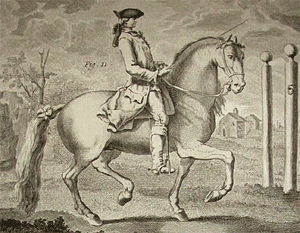
...is the "descendant" of what was once considered the ultimate and purest form of all riding. "Manège riding"
was seen as both the foundation, the proto-type of all riding, and as
its pinnacle, its highest expression. All other riding was taken
to be but a lower-level form, a but fragmentary representation of this
"essence" and therefore reducible to it. This idea was the outcome of
a complex historical process of trying to understand how to transform a horse into a riding horse. The horsemanship we speak about here carries on the tradition (long in developing!) for which education is the determining element in equestrian undertakings.
recognizes, on the basis of evidence, that for all minimally demanding forms of riding the horse must be taught, but that only by teaching him in a certain manner will he be, and remain, healthy in mind and body and therefore safe, useable, and comfortable. What one can make the horse do and satisfy these expectations is therefore limited, and one must restrict oneself accordingly
in what and how one teaches the horse. Proper education of the horse
presupposes proper education of the rider, restraint with depth, i.e. knowledge and understanding.
¦...is the application of these fundamental ideas, which are generalizable for all forms of riding, to a particular set of equestrian objectives and means for obtaining them.
Only relatively recently (by the early 19th century, approximately) did
it become obvious that different forms of riding demand different
equilibria (of horse and rider) and that equestrian methods have to
vary accordingly. In a modern perspective, "School riding" is not
"general riding carried to its highest form" but one among several
distinct versions of horsemanship, a particular focus demanding
specific methods. It is a specialization.
It must be understood in this its particularity because only then can it be
practiced in the proper manner and only then does it become possible to attain the
higher difficulties. Practiced as a Liberal Art, combining the
demanding dexterity of the
crafts/wo/man with the acuity of the informed intellectual and the
sensitivity of emotional maturity, such riding merits to be called
- in the most honourable traditional sense of "deep searching" - Academic Riding.
… is thus profoundly paradoxical and complex. The reformulation of nature it aims for must leave no traces of the "unnatural" process of achieving it.
Only by slowly building physical strength combined with flexibility
will it lead to gracefulness without vulgar obvious muscularity, to a
show of airiness and lightness by a heavy animal carrying a load. Only
by progressively refined collaboration and "dialogue" will it result in
a performance according to the rider's demands, yet given as if by the
horse's voluntary inclination, in habitual behavior yet without a hint
of mindless mechanization. Compromises or mistakes in the educational process will always taint the outcome.
…proceeds toward the horse's transformation by exercising his mind and body. In all phases, the exercises are the means
to obtaining this objective, never are they objectives themselves. Only
a rider who understands this will have the necessary "detachment" from
the exercises (while cultivating their perfection) and will therefore
transcend making the horse do things, i.e s/he will attain a form of riding in which one lets the horse do that which is requested because the horse has been taught to understand (not simply to obey).
...derives its guiding values from the principles of the following traditions of horsemanship: from classical Greek horsemanship, the ideal of humane treatment and of aesthetic intention; from Berber/Moorish/Muslim Iberia
(7th to 15th century), the ideal of the emotionality of the brilliance
and lightness of the omnidirectionally mobile horse; from Celtic/Frankish
mythology, the ideal of the learning horse as an image of growth (from
untamed brutishness to trained airiness) and thus, for the human being
doing horsework, the concept of its psychological rôle as part of the
process of self-actualization and maturation; from Italian/French Renaissance (to 16th century), the ideals of grandeur, grace, and of the "theatrical" applied to riding as creativity, and from the Baroque, the idea of complexity as a mark of quality; from European Enlightenment (18th century), the ideals of logic and of rationally systematic method as the foundation for practical horsemanship; from the mechanistic and scientific frameworks
of the 19th and 20th centuries, the model of biodynamics and of
behaviour modification, and the consequent techniques; and from the
ongoing sociocultural "discussion" of the last 150 years (i.e. from the
differing perspectives on horsemanship in the cavalry, in the
"entertainment industry", in professional vs. amateur sports, and in leisure), the
various ideas on competing, on "showing", and on competence.
… counts riders among its practitioners, on the other hand, whose style
of riding may not, by common standards, appear to be close to
"school/academic/dressage/classical riding" but whose horsework is in strict
adherence to the values of these traditions. In short: There are
riders who (knowingly or not) make a sham of these traditions while
presenting semblances of them, while there are others who (recognized
or not) truly cultivate them and extend their essence to modern-day
equestrian styles and disciplines. This is the reason why neither
looking at the appearances and forms of somebody's manner of riding nor
listening to the wordy self-justifications assures, unless one is
a very astute critical observer, that one can "see" how close to this
horsemanship's value system somebody's practice truly is.
...therefore considers it to be unnecessary, at best, and presumptious
to "reinvent the wheel" or, worse, to ignore the experience, knowledge,
and insights of our predecessors and to "innovate", both in the realms of practice and of theory. It humbly respects
the authority of accumulated experience and insight which undergirds the teaching of the Masters. Central to their
wisdom is the conviction that horsework which uses "any"
means which justify the ends, simple empiricism, is most always, over the long or the short, just as disastrous for horse and
rider as the application of a dogmatically set "system". Properly understood, the principles of this horsemanship are statements on what one must not do and the rider's practical application consists in discovering which of the things s/he "does" can be left undone.
…consequently defines the "correct ways of doing" as
those practical means which connect these two sets of values, which effectively link motivations with objectives. Method
and technique must bear out the value principles enshrined in motivations and
objectives
- this is what the myriad hours of practical horsework and critical
assessement by
past masters teach. Were we not to gratefully accept these lessons, we
could hardly expect to discover this in our own limited riding
life-time, our practical know-how would never measure up to the
heartfelt
goodness of our intentions. This horsemanship has a value perspective on the question of the acquisition of competence.
...is as paradoxical in what it attempts to achieve with the horse - to form and transform without deforming - as
it is in what it demands of the rider: The "balancing act" of
emotionality and rationality, the search for their integration,
is a transformatory process for the rider. In our epoch of
predominantly leisure, amateur, or sport riding, this exigency has come
to be seen in a new light. The notorious call to be a "feeling and
thinking" rider (i.e. to cultivate caring and carefulness, finesse of
sensation, and methodical mindfulness) is undeniably a necessary
precondition for refined horsework, but it is not a sufficient
condition for the practice of the specific horsemanship we speak about
here. This horsemanship requires adherence to fundamentals which must
be respected and is, in this sense, a replicating practice; yet, by virtue of its self-critical methodology, it is also a fundamentally creative undertaking and therefore demands flexible inventiveness.
…is thus an endeavor which has dimensions comparable to those of the challenge of the plastic arts and crafts. Ideally, shaping the horse aesthetically leads to expressiveness and to an interpretation of the horse's true nature, to an "artifice" which produces an impression and experience of "noble simplicity" and "serene grandeur".
These words of Winckelmann's seminal 1755 definition (originally
applied to Greek sculpture) point to the real meaning of the notion
of classical
horsemanship. Expressionless or stereotypically "regulated" riding,
however "complicated", is as un-classical as that which is "impressive"
by its vulgarity and exaggeratedness.
... gauges horse-appropriateness by the exacting standards of whether the work makes the horse healthier, longer living, brighter and more beautiful
despite his "unnatural" conditions of life and however "unnatural" the
presence of the rider or the demands of the work may be. This standard
applies at every moment and over any time span, i.e. it must never
be eschewed. The rider's immediate, short-sighted utilitarian interests
are therefore, in this horsemanship, not valid criteria and promises of
false, facile gratification are but distractions, at best, if not
guarantees of failure. Only when the work with the horse is
horse-appropriate can it embellish the horse in its natural characteristics,
i.e. only then can this horsemanship's objective be reached.
…is therefore, if present, publicly visible, accepted, and a factor of
cultural import, a symptomatic indicator of the degree of civilizedness, individually and collectively. As horses deformed by denaturing
horsework bespeak barbarity, so also the degree of pervasiveness of
examples of horses and riding in the vein of the horsemanship we speak
about here, of truly classical horsemanship, gives proof of the refinement of a time and culture. Our
"version" of this horsemanship today can only hope to act as yet
another link in the historical chain, provided we learn to the fullest
the principles it has taken so long to generalize and abstract,
provided we practice according to these canons, and provided we
further the understanding of
horse-appropriateness in the light of our epoch's novel insights yet always in
respectful acceptance of the time-honored methods.
...is calm, because before the backdrop of history it is unhurried; is
silently humble, because it seeks but to make the horse "speak"; is
patient, because progress in refinement presupposes a painstaking
acquisition of the mastery of method and the penetration of principles and values; is self-critically
aware because all "feeling" (both sensation and emotion) as a basis for
interacting with the horse can be mistaken or illusional and must
therefore be taken with a grain of salt; is realistic and rational, because only the
actual condition of the horse (and not the laudable good intentions of
the rider) tells the truth; and all horsemanship in this vein is proud
(not vain!), because whatever point of progress it reaches through
proper practice, it always achieves a (though maybe modest)
exemplary reconstitution of the horse's nature. And that makes this horsemanship, despite it often being a "rocky road", joyful.
DIDEROT 1769